
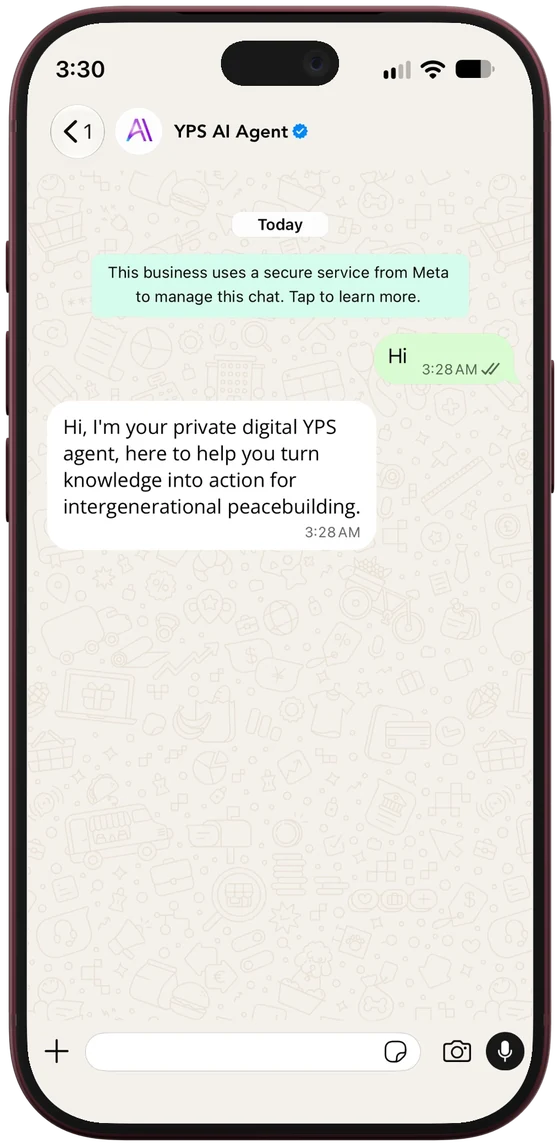
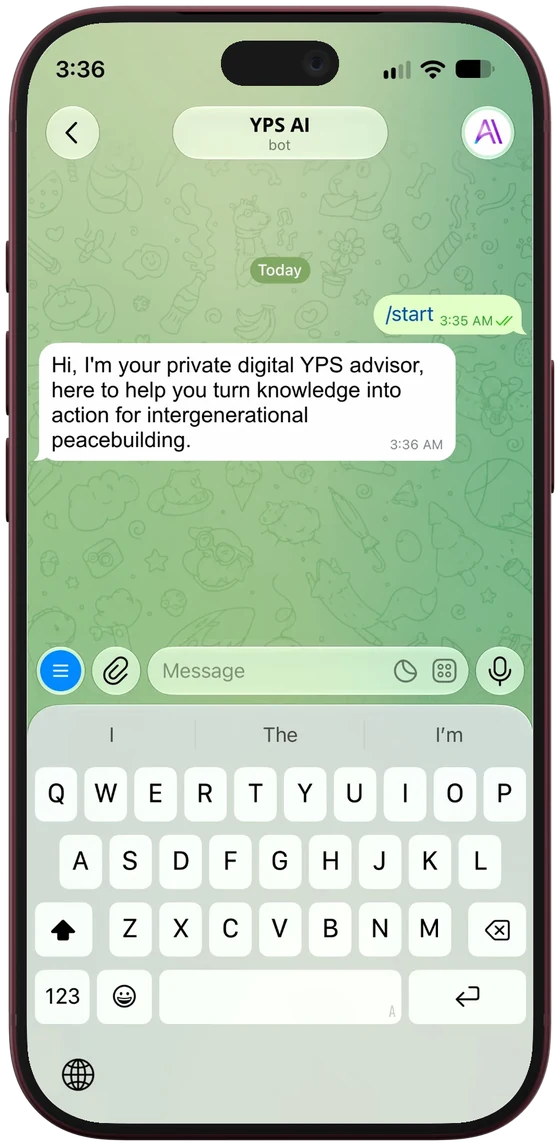


















The choices behind YPS AI.
A single agent with an eight-layer instruction stack follows one reasoning process, making its behavior easier to trace, test, and improve.
Its retrieval layer draws on nearly 500 public YPS documents. The curated collection brings together policy, research, and field evidence, with sources categorized to preserve those distinctions.
What is YPS?
The Youth, Peace and Security (YPS) agenda, established through UN Security Council Resolution 2250 in 2015, is a global framework that helps governments and institutions involve young people in preventing conflict, shaping decisions, and building safer communities.
Think of it as a way to ensure sustainable peace and security by giving young people real influence, protection, partnerships, and pathways to contribute constructively.
Knowledge for meaningful participation
YPS does not have a knowledge shortage. Years of UN resolutions and frameworks, UN publications, regional organization documents, national action plans and strategies, civil society and NGO resources, and academic research are scattered across organizations, buried inside long documents and often inaccessible to people who do not already know where to look. YPS AI was built to make that accumulated knowledge easier to find, understand and use without replacing the people, institutions and communities who give it meaning.
Built for people doing the work
A youth leader preparing for a policy consultation should be able to access the same evidence as the policymaker sitting across the table. A policymaker should be able to quickly explore how other countries approached a problem. YPS AI helps both find relevant evidence without needing to know which organizations or documents to start with.
Co-designed with the Community
Members of the YPS community around the world tested YPS AI Agent, and their feedback was considered at every stage of development.
That feedback matters because technical performance alone does not make a tool useful. People working in the field bring questions, constraints, and experiences that a small team cannot fully anticipate. Their perspectives help guide decisions about what the agent should do, how it communicates evidence, and where its limits need to be clearer.
Access without an account
No account. No login. No personal profile. Privacy is treated as part of access, especially in a field where researching governance, civic space, conflict, or security can itself be sensitive.
Free to use
Access to public-interest knowledge should not depend on the ability to pay. YPS AI Agent is available at zero cost to users. There is no subscription tier, premium answer, institutional license, or paywall between someone and the knowledge base.
Available in 61 languages
The YPS agenda is global. Much of its documentation is not. YPS AI Agent can be used across 61 languages, allowing people (especially in Africa) to ask questions and explore YPS knowledge in languages they better understand.
Answers you can check
AI can produce confident language. That is not the same as evidence.
YPS AI provides citations so users can move beyond the generated answer and examine the underlying sources themselves. The goal is not to create a new authority between people and the evidence. It is to make the path back to the evidence shorter and access to it easier.
A focused public-interest tool
YPS AI Agent was not designed around how many AI features could be added. It was designed around what people working on Youth, Peace & Security actually need: trustworthy knowledge, low barriers to access, privacy, evidence they can verify, and room for human judgment.
No login required. Zero cost. 61 languages. Local conversation storage. Source-linked answers. A curated YPS knowledge base. No unrestricted web search. Human judgment stays in control.
Individually, none of these choices is revolutionary. Together, they represent a different idea of what AI for peacebuilding can look like: useful without becoming intrusive, accessible without monetizing access, and powerful without pretending to know more than it does.