Identity-free access
Use the agent without creating an account or sharing personal identifiers.
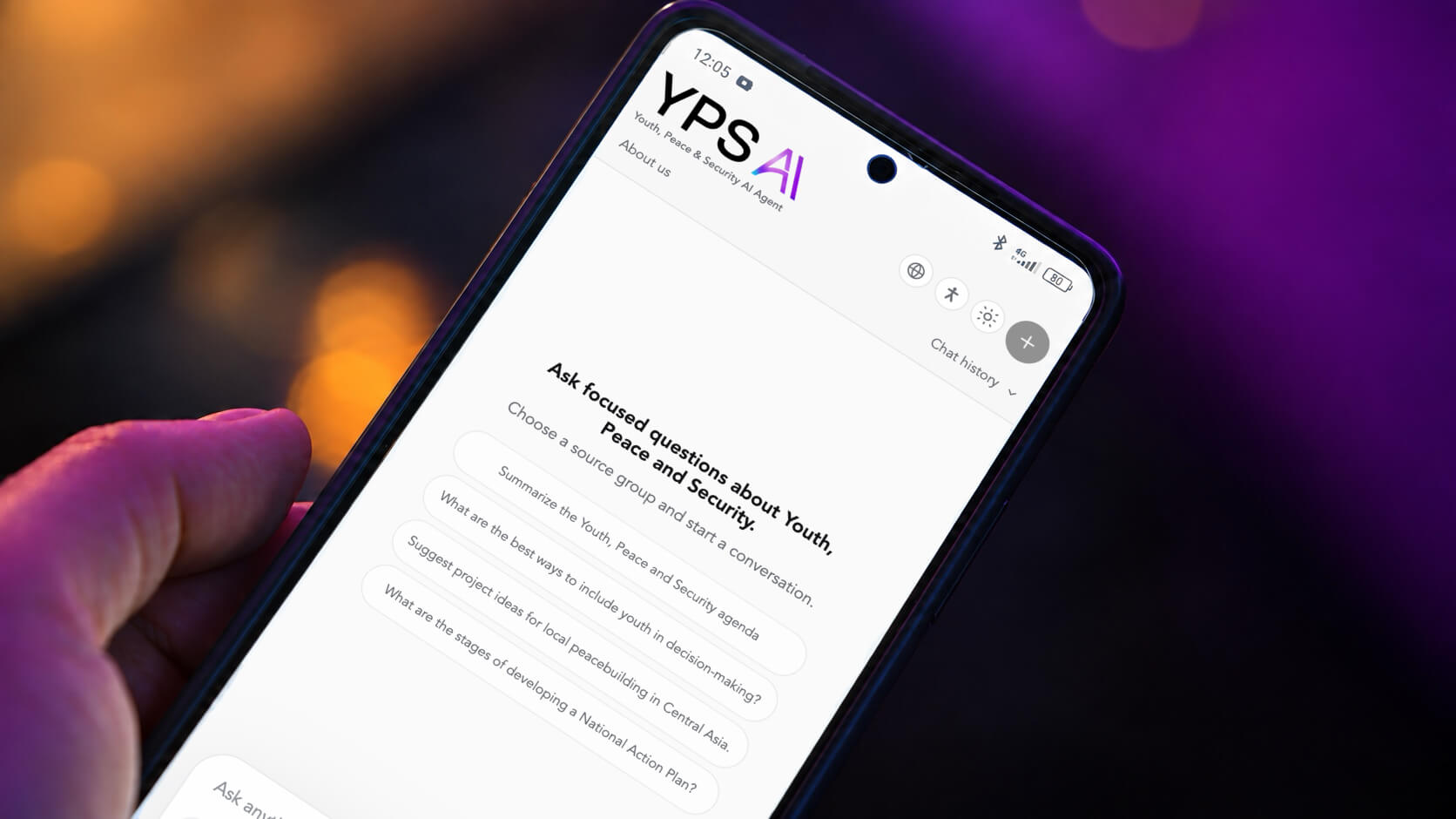
YPS AI Agent makes the accumulated knowledge behind the Youth, Peace & Security agenda easier to find, understand and navigate.
Built for youth leaders, peacebuilders, policymakers, civil society and researchers, it connects people to evidence across hundreds of YPS frameworks, national strategies, research publications and field resources, without monetizing access or turning access into a personal profile.
Use the agent without creating an account or sharing personal identifiers.
Conversations do not become personal or behavioral profiles.
Keeps the thread of a session without turning context into identity.
Grounded in Youth, Peace & Security knowledge, sources, and terminology.
Focused capabilities and clear boundaries reduce the space for misuse.
Ask questions and explore evidence in the language that works for you.
A low-friction experience designed for different abilities and devices.
Supports human judgment and participation—never replaces them.

YPS AI Agent uses a single-agent architecture with an eight-layer instruction stack and one ordered reasoning process. This makes the system easier to trace, test and improve, while reducing the hidden handoff errors and added latency that can come with multi-agent orchestration.
Reliable reasoning depends on reliable evidence. Its retrieval layer draws from nearly 500 public YPS documents, including United Nations and regional frameworks, national strategies, academic research, civil society evidence and case studies.
At the core is a curated knowledge base that brings together institutional knowledge, research and lived experience. Sources are categorized so the agent can distinguish between policy, recommendations, interpretation and evidence from practice, helping it reflect different forms of knowledge without treating them as interchangeable.
YPS AI Agent was not designed around how many AI features could be added. It was designed around what people working on Youth, Peace & Security actually need: trustworthy knowledge, low barriers to access, privacy, evidence they can verify, and room for human judgment.
YPS does not have a knowledge shortage. Years of resolutions, national strategies, research, field evidence, and practical guidance are scattered across organizations, buried inside long documents and often inaccessible to people who do not already know where to look. YPS AI was built to make that accumulated knowledge easier to find, understand and use without replacing the people, institutions and communities who give it meaning.
A youth leader preparing for a policy consultation should be able to access the same evidence as the policymaker sitting across the table. A policymaker should be able to quickly explore how other countries approached a problem. A peacebuilder should be able to find field evidence. A researcher should be able to trace an answer back to its source.
YPS AI is built for youth leaders, civil society, peacebuilders, policymakers, practitioners, students, and researchers. Different users may ask different questions, but they should not need specialist knowledge of the YPS ecosystem just to begin.
YPS AI was tested with stakeholders around the world, and their feedback was considered at every stage of development. Their involvement helped connect the system’s development to the different settings in which YPS knowledge is used.
Technical performance is only part of whether a tool is useful. The people working with it bring questions, constraints and experience that a development team cannot fully anticipate. Their perspectives belong in decisions about what the agent should do, how it communicates evidence and where its limits need to be clearer.
The aim is a tool shaped by the field it serves, with stakeholder experience informing development alongside technical expertise.
No account. No login. No personal profile.
You can open YPS AI and start asking questions without giving anyone your name, email address, or creating an identity around your use of the platform. Conversation history is stored locally on your own device. Privacy is treated as part of access, especially in a field where researching governance, civic space, conflict, or security can itself be sensitive.
Access to public-interest knowledge should not depend on the ability to pay. YPS AI is available at zero cost to users. There is no subscription tier, premium answer, institutional license, or paywall between someone and the knowledge base. The aim is simple: a youth organization with limited resources should be able to use the same tool as an international institution.
The YPS agenda is global. Much of its documentation is not.
YPS AI can be used across 61 languages, allowing people (especially in Africa) to ask questions and explore YPS knowledge in languages they better understand. It does not solve the deeper problem of whose knowledge gets published or translated. The translation is also not very accurate, but it can reduce the language barrier between existing evidence and the people trying to use it.
AI can produce confident language. That is not the same as evidence.
YPS AI provides citations so users can move beyond the generated answer and examine the underlying sources themselves. The goal is not to create a new authority between people and the evidence. It is to make the path back to the evidence shorter and access to it easier.
Peacebuilding cannot be automated. YPS AI can help someone understand a framework, compare approaches, identify evidence, or prepare for a conversation. It cannot determine what a community wants, replace lived experience, negotiate legitimacy, make political choices, or decide what should happen next.
The system is designed to strengthen human agency, not substitute for it.
No login required. Zero cost. 61 languages. Local conversation storage. Source-linked answers. A curated YPS knowledge base. No unrestricted web search. Human judgment stays in control.
Individually, none of these choices is revolutionary. Together, they represent a different idea of what AI for peacebuilding can look like: useful without becoming intrusive, accessible without monetizing access, and powerful without pretending to know more than it does.
Meaningful participation requires more than access to information. YPS AI contributes primarily through access to knowledge. It can help people investigate the rules, commitments, research and experience surrounding a decision.
It cannot determine what a community wants. It cannot substitute for deliberation. And it cannot make an institution share power. It helps people arrive at those processes better prepared.
Access to evidence.
People’s firsthand understanding of the realities being discussed.
Weighing perspectives and deciding together.
Interpreting evidence in context and weighing consequences.
The freedom and capacity to shape one’s own choices.
Turning shared intentions into practice.

User prompt selected.
Several capabilities were deliberately narrowed to keep answers reliable, protect privacy, reduce the risk of misuse, and control costs.
Its scope is limited to Youth, Peace & Security and closely related peacebuilding questions. Its knowledge comes from a curated YPS corpus. The system is designed around evidence, clarification, traceability, and visible limits. These constraints are not missing features. They are part of the trust model.
The agent does not browse the web for information or build its own knowledge base from web content. Every response is grounded in the curated corpus.
Users cannot upload their own documents to the tool. This is a deliberate design choice to protect privacy and keep operating costs manageable so the tool can remain free.
The agent is not a document processor or a general-purpose assistant.
No login, cookies, or personal identification are required. The system does not request, collect, or store information that identifies users.
Chat history is stored locally on your device. Contextual memory is limited to the active conversation; a new chat does not inherit another chat’s context.
Contribute to the knowledge base
The agent was built by a small team independently. Product design, AI development and deployment, and advisory input were intentionally held as distinct roles, bringing technical, field, and institutional perspectives into the work.
Advisers were included because the quality of the system depends not only on how it is built, but also on how well it reflects the field it serves and the standards of evidence, reliability, and responsible use expected within it.
Yahya Qanie
Murtaza QanieSenior, Artificial Intelligence, UC Leuven-Limburg
Senior, Finance, American University of Afghanistan
Lena SlachmuijlderSr. Advisor, Digital Peacebuilding, Search for Common Ground
Co-Chair, Council on Tech and Social Cohesion
Saji PrelisDirector, Youth & Children, Search for Common Ground
Co-Chair, Global Coalition on Youth, Peace & Security
Yorke E Rhodes IIIDirector, Traceability & Co-Founder, Blockchain, Microsoft
Adjunct Professor, Center for Global Affairs, NYU SPS